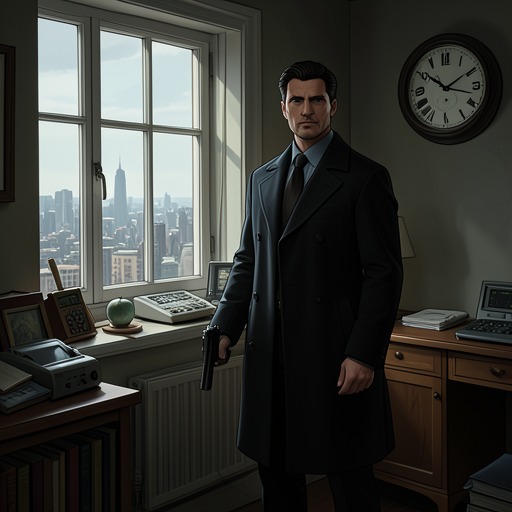
Amos Crane and Michael Downey
Down Cemetery RoadThe relationship between Amos Crane and Michael Downey is a contest of pursuit that becomes personal on both sides: Amos wants to avenge his brother Axel, while Downey is driven by the search for Dinah Singleton. Their conflict is sharpened by the state’s concealed violence against Downey and his fellow soldiers, and by Amos’s growing recognition that this fugitive is not simply another target to eliminate.
A Pursuit Made Personal
After Axel’s death, Amos withdraws into the garden and empties his mind for about twenty minutes. The stillness is a deliberate interval in which he does not pass through the usual stages of grief; he accepts that his brother is dead and concludes that the game is not over, only more important to win. His thoughts then turn to the island and to an imagined encounter with Downey: the two men alone in the dark, unarmed. The fantasy is intimate and violent, focused on what Downey’s flesh would feel like beneath Amos’s hands. The memory is identified as one from the future, giving the feud a menacingly anticipatory quality: Amos imagines a confrontation before it happens, and the imagined violence already binds them together.
Amos turns that hostility into a methodical search. At seven in the morning, after only three hours of sleep, he works through railway timetables, assuming that Downey and Sarah Trafford may have fled by train. He rules out London and the north, reasoning that a crowded city would not make a fugitive disappear and that a long journey would risk meeting a waiting police car. He tries to think as Downey would, but also considers what Sarah might do and whether Downey would keep her close while learning what she knows. The hunt is therefore not simply a chase after a man: Amos treats the fugitives’ choices, their limited time, and their need to communicate as clues.
His deductions become increasingly specific. Amos allows a ninety-minute window for possible departures and considers that Downey may have bought two identical pairs of tickets to plant a false trail. Because Downey could not safely return to the ticket window, Amos reasons that Sarah may have bought them. He uses an illegal computer search to narrow the possible ticket-pair combinations, then settles on Malvern and Worcester as likely destinations. The painstaking reconstruction makes Amos formidable, but it also shows him entering Downey’s reasoning rather than merely following a trail. He is trying to anticipate a man whose choices have already disrupted the operation and killed Axel.
The Cause Behind the Target
The pursuit is rooted in a military secret that changes what Downey represents. He tells Sarah Trafford that the men were driven into the desert under the pretense of a combat exercise against enemy forces. The targets were boy soldiers; Downey and the others were ordered to bring them back alive, while the real purpose was to expose the soldiers to a weapon and test its effects on them. Downey describes a blast like breaking glass, air that turned muzzy, and pain that seemed to burn through his skin. Tommy Singleton tried to stop him from looking, but Downey saw the children melting. The memory makes the official language of an exercise or test grotesquely inadequate: the soldiers were both instruments of violence and its experimental victims.
The cover-up extended beyond the desert. Downey explains that the surviving men were taken to The island, where their guards initially presented themselves as ordinary men making sure the prisoners were all right. The soldiers were repeatedly promised that they would go home soon. Only later did one guard tell Tommy Singleton that they had all been declared dead in the helicopter crash near Cyprus, although Downey says he had never been to Cyprus. The supposed caretaking becomes legible as captivity: the men were not held for their protection, and their official deaths made release dangerous for those responsible. Downey believes the authorities could neither let them go after announcing they were dead nor execute members of the armed forces without political cover. His account gives his flight a cause beyond survival and turns the hunt into a collision with a state effort to erase its own crime.
That cause distinguishes Downey from the target Amos’s records seem to describe. Howard recalls that the files classified Downey as a dependable soldier who followed orders, but Downey is now alone, has killed Axel Crane, and is pursuing Dinah Singleton. Howard recognizes that a soldier acting for a cause is unlike the routine targets Amos has dealt with; Amos, meanwhile, insists that he will find Downey. Their conflict therefore rests on opposed forms of loyalty. Amos’s pursuit is personal after Axel’s death, while Downey’s determination is bound to the concealed history of the men and children harmed by the operation and to his search for Dinah. Howard fears that if Downey survives long enough to speak, the state’s responsibility could become public. The private feud and the institutional cover-up converge around the same fugitive, but they do not mean the same thing to either man.
The Hunt Turns into a Test of Judgment
The pursuit also exposes the difference between the two men’s positions inside the same machinery of violence. Howard reminds Amos that working from a desk has left him with civilians close to official secrets and a fugitive somewhere in a vast field of possibilities; Amos answers that he will find Downey. Yet Howard’s criticism is not simply that the search is difficult. Amos had trusted Axel to handle the operation, and Axel is dead. His certainty now has to contend with the consequences of that earlier judgment, even as grief and anger threaten to make the hunt more personal than strategic.
Howard nevertheless understands why Downey is dangerous in a way the file cannot capture. The records describe a man who obeyed orders, but the fugitive has already killed Axel and now has a cause. Howard recognizes that a soldier fighting for something is not interchangeable with the targets Amos has previously pursued. Downey’s search for Dinah gives his flight a direction and a purpose; it also means that predicting him requires more than assuming he will simply keep running. In Howard’s assessment, the same purpose that makes Downey more than a routine target may carry him into Amos’s reach.
Amos’s own calculations begin to circle around that possibility. He considers whether Downey has spent months relying on Thomas Singleton’s judgment, and whether, now that Singleton is absent, he might be lost or even hoping to be caught. He does not believe the thought, but he cannot dismiss it. Later he heads for King’s Cross, convinced Downey will have realized that Dinah is being used as bait and that the island is where he must go. Amos treats the trap not as a secret the fugitive will fail to see, but as a move Downey may recognize and choose to answer. His estimate also incorporates Sarah Trafford: Axel had described her as intelligent, and Amos allows that she could affect Downey’s decisions. The pursuit thus becomes a contest in which each man’s attachments are part of the other’s calculations. Downey’s concern for Dinah draws him toward danger; Amos’s effort to anticipate that choice brings him closer to the man he wants to punish.
Unequal Knowledge and Motives
The connection between Amos Crane and Michael Downey is sharply unequal: Amos makes Downey the object of a concentrated pursuit, while the evidence here gives Downey no comparable knowledge of Amos. Amos imagines them alone together, unarmed, and turns his brother’s death into a reason to win; Downey’s revealed purpose is elsewhere, in reaching Dinah Singleton. The gap matters. For Amos, the fugitive is already a personal enemy. For Downey, the danger gathering around him is bound up with the child he is trying to find and the past the authorities have concealed.
Downey’s motives are not reducible to a soldier’s loyalty or a simple wish to rescue a child. When Sarah Trafford asks whether Tommy Singleton is the reason he is looking for Dinah, Downey says that Maddy Singleton is. That answer makes his pursuit personal in a different register from Amos’s: it is connected to Maddy and to Dinah, rather than to revenge for a dead brother. It also gives Amos’s prediction about the island its force. He believes Downey will recognize Dinah as bait and still come, because the attachment that leads him there is stronger than the logic of escape.
The account Downey gives Sarah also resists turning him into a morally uncomplicated counterweight to Amos. He describes a soldier capable of following orders and enduring the desert experiment, but also recalls Tommy beating a stranger nearly to death and admits that he could have stopped him only by killing him. Downey’s verdict is unsentimental: Tommy was a good soldier, not a nice man. The distinction complicates the whole pursuit. Amos’s personal vengeance does not make Downey innocent, and Downey’s cause does not erase the brutal conduct of the men shaped by military life. Their opposition is therefore not a clean contest between villain and victim, but a collision between a bereaved pursuer and a fugitive whose purpose is bound to love, danger, and a history of violence.